

Breaking Up Is Hard To Do
Written by Paul Siluch
September 01st, 2026
Once great friends and neighbours, the U.S. and Canada are now locked in both a war of words and a war of trade. News reports say that a trade deal came within hours of being signed, only to have one side – or both, pick your story – walk away at the last minute.
Canada’s anger at the U.S. is deep-seated. I remember my mother, a United Empire Loyalist, if there ever was one – always bearing a grudge at Americans. Some say it goes back to the days when British Loyalists fled the new Republic after 1776, swearing loyalty to the King rather than a new president. Canada has lived in the shadow of a giant for its entire existence and has faced threats of absorption several times. Some argue that suspicion, envy, and anger still permeate Canada and recent events have stoked them hotter.
This has led to the current trade war. Tariffs have been levied on Canada, and we have counter-levied tariffs on everything from copper wire to honey.
A trade war with an economy ten times your size is a delicate balancing act. Canada relies on the U.S. for over 70% of our exports compared to them sending just 17% of their exports to us. Canada has more to lose.
Leaders in Ontario are hinting at cutting off electricity exports to the U.S. While some argue this would be a dangerous escalation, we may end up doing this anyway. That is, unless we start building more generation capacity.
Back in 2016, when the first CUSMA deal was signed, Canada had extra electricity to burn. Somewhere around 10% of our electricity – 64 TWh – was surplus and available for export (Canada Energy Regulator).
Which we did. New York and its neighbours were happy to take all the spare electrons we had.
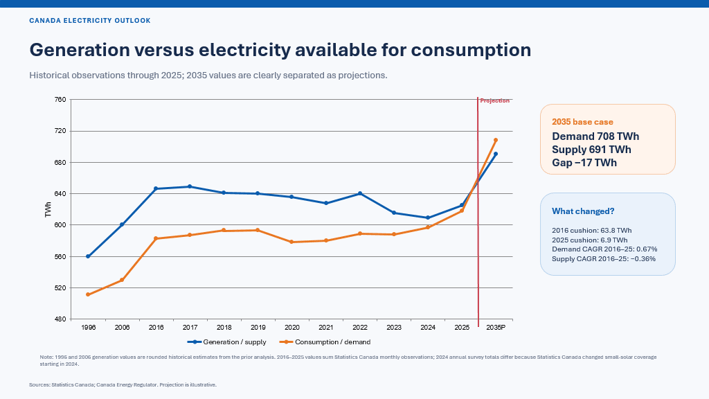
By 2022, however, the surplus was down to about 8% (49 TWh). And by 2025, we barely had any surplus – about 1% (7 TWh).
Why?
Warmer winters and less snow for our hydro dams were one reason. A surge in electric cars (EVs), heat pumps, electric scooters, and electric toothbrushes ate up the rest.
Are we using less electricity? I’m not. I heat my bathroom floors now and installed garden lighting last year. We are all using a lot more electricity and our generative capacity has not kept up. What else is coming? Two friends have recently bought autonomous lawn mowers, and the City of Victoria now uses them as well.
Suffice to say, we may end up cutting off American electrical exports whether we sign a trade deal or not. You can’t export what you don’t have.
Which brings focus to a couple of stocks we have owned for a long time:
Fortis and TC Energy (the old TransCanada Pipelines).
Fortis is BC’s largest publicly traded electricity transmission company (next to BC Hydro) and one of Canada’s largest as well. Because Fortis focuses on transmission lines, substations, and the grid to distribute electricity, it is less dependent on electricity prices. We view it as an electric “picks and shovels” company that offers consistent growth in revenue and dividends.
TC Energy is primarily known as a natural gas pipeline company. It generates power from natural gas generators but hidden inside this pipeline company is a 48% ownership of Bruce Power, the nuclear facility in Ontario that generates one-third of Ontario’s electricity. Bruce Power generates three times what B.C.’s new Site C dam generates.
Bruce Power is being expanded by 2030, which will add to TC Energy’s revenues.
U.S. Estate Tax Exposure
The United States is one of just two countries in the world that taxes its citizens wherever they are, not just those within its borders.
Eritrea is the other, in case you were wondering.
In Canada, you only pay taxes when you are a resident. If you sever ties and move away, you stop paying Ottawa. But the United States taxes its citizens everywhere and always on global income. If you pay enough in your new country, you will owe nothing. But you still have to report back to Washington.
Not only that, but the U.S. also taxes “U.S. persons” – anyone who owns U.S. assets. You may think this is confined to real estate, but it includes U.S. stocks. If you own more than U.S. $60,000 in U.S. stocks on the day you die, your estate must file an IRS Form 706-NA proving you fall below the U.S. estate tax minimum of U.S. $15 million.
$15 million is a high number. Most estates will never come near this. But some will. Add in insurance, your home, RRSPs, and TFSAs – things you may have thought were exempt but are not – and some estates will exceed the U.S. $15 million mark.
The $15 million U.S. estate tax exemption level is not fixed in stone. Under previous U.S. administrations, it was as low as $6 million, a number many Canadian estates could hit.
We have a calculator to estimate U.S. estate tax exposure and can discuss ways to mitigate them. Contact us or your accountant if you want to discuss this further.
Estate Fire Drills
I read recently about a colleague of ours in Toronto who conducts “estate fire drills” with his clients. He has them pretend they died yesterday and then look at what happens next.

It would be a shock, of course. It can also be needlessly complicated and confusing when your financial details are not written down. Bank account numbers, named beneficiaries, passwords, travel point websites, powers of attorney – having all of these in one place makes an executor’s work much easier and less expensive to carry out.
We offer a free booklet to help people organize their information. It easily fits into a drawer, safe, or safety deposit box.
Call and ask for one today.
Farewell to Glenda
You learn a great many things about investing over a 40-year career. Most of them come from the people you meet.
We’ve gone through six major crashes and a dozen minor corrections over the years. During most of these events, we receive many panicked calls from people worried about their holdings and asking if they should sell. Most don’t. The few that do rarely return to investing. It’s just what happens.
When markets fall, they often fall violently. Then they recover somewhat, only to slump a second time. It is this second drop that traps most people. You think it is safe and the worst is over, but there is often a second shoe to drop.
And that is when the phones go silent. People are too shell-shocked to sell, but they sure didn’t want to buy either. Even when there are bargains to be had. And we, as advisors, are worn out too. After talking dozens of people off the ledge, you become fearful and uncertain yourself.
We lost a very good friend and client named Glenda this year. She was charming and patient but also whip-smart about her investments.
Glenda’s superpower was that she was wired the opposite way to most investors. Close to the bottom of every decline, the phone would ring. It was Glenda.
“I think it’s time to do a little buying,” she’d say. She never asked if she should buy. She asked which stocks she should buy.
And what did she pick?
Dividend-paying stocks of companies that would survive. Banks, railroads, pipelines, utilities...anything high-quality that was down and hated. She had Warren Buffett’s sense for value and a hunter’s nose for timing. She grew her family accounts like few I have ever seen because she was always brave at the bottom and rarely sold what she bought.
Funny enough, I also had a client who called near the top of every market. He didn’t know it was the top – he was simply calling to thank me for doing such a good job.
At first, I loved the praise. What a genius I was. Over time, though, I realized it was just the natural market cycle: we feel happiest at the top.
And those tops were almost always when he called to say thanks. He was an excellent market timer and never knew it.
Glenda was the polar opposite. She was almost always right when markets were about to bottom, and she gave me the courage to start buying. Just when I needed it.
Her ability to focus and tune out fear taught me a lot, and I miss her and her timely calls already. I hope I’m that wise bottom-caller now, after being trained by the best. Glenda truly was the best market-timer I have ever met.
Farewell, my dear.