
The Second Half
Written by Paul Siluch
July 4th, 2023
It’s July now. The midway point of the year. Half-way home.
At the beginning of 2023, many analysts predicted that the year would start weak and end strong. Instead, we’ve had just the opposite. Canada’s main index is +5.7 per cent to start the year, while the Nasdaq has soared over +30 per cent.
It’s not all great, though. Global bonds are -0.94 per cent for the first six months. We’ve raised interest rates steadily since January, and bonds hate this.
And it is not a bull market for all sectors. If you were invested in technology shares, it is the World’s Fair for you. Canada’s technology index (S&P/TSX Global Technology ETF) is +40 per cent to June 30th. If you were invested in banks? Up just +3 per cent (S&P/TSX Financials ETF).
So, where to, from here?
In the world of sports, if a team is leading at half-time, it goes on to win 75 per cent of the time (Occidental College). That is, unless you were the Chicago Cubs in 1969. The baseball team was in first place as September started, when a black cat ran into the dugout. This ushered in 17 losses over the next 25 games, and the team missed the playoffs.
In markets, it has been even better since 1950. Since 1950, the S&P 500 was positive in 82 per cent of the years when stocks were up as of June 30th (source: Zack’s).
Not bad odds.
Now, there are bound to be pauses. Since 1950, the average ‘dip’ between now and December is -9 per cent, so be prepared for some giveback.
As much as we want the market to continue its rise, and we certainly hope it does, there remains the possibility that things won’t be so rosy.
- The economy is not that strong. Manufacturing and exports are down, with just construction and personal spending on travel and restaurant holding us up.
- Employment numbers are steady, with just modest layoffs because businesses do not want to let good workers go. New job openings are drying up fast, however, which often is the first step before layoffs start.
- Can’t forget interest rates. Every one-quarter percent rate hike sends the average variable mortgage higher by $100 per month (Financial Post). Many five-year mortgages are resetting to the new high rates in the next year, so banks are setting aside loss reserves because they are afraid you won’t pay.
We enter the second half of 2023 a little wary, as a result.
Hi Ho…Silver?
At the end of every day, I like to ask myself what I learned today that I did not know yesterday. I read extensively and have recently been investigating something very old that is new again.
Today, I want to talk about silver.
I had a debate several years ago with a colleague about Tesla. He was a raging Tesla bull while I was a bear. His argument was that an electric car contains just 1/10th the number of parts that a gasoline engine does and so, is far more efficient. My argument was that, no matter how efficient the engine was, the batteries would never equal the energy density of gasoline.
While that argument is still an ongoing one (he was right about the manufacturing and complexity, but I am still right about the limited range of battery-powered electric engines), I must concede that Tesla has been a success in terms of selling vehicles. It is the #1 electric vehicle maker in the world and now commands 4.1 per cent of the North American market.
Not bad for a company formed in just 2003. Here is the current North American market share data from March 2023:
16.5% GM
13.8% Toyota
12.3% Ford
11.0% Stellantis
8.7% Honda
5.8% Nissan
5.5% Hyundai
5.2% Kia
4.1% Tesla (Model Y is the world’s best-selling vehicle in 2023)
4.0% Subaru
2.4% Mazda
2.3% Mercedes
2.2% BMW
1.9% VW
1.3% Audi
0.8% Volvo
source: marklines.com
Tesla is selling more than Subaru and Mazda, and is closing in on Nissan. While I may yet be right that battery technology remains an ongoing limiting factor for electric vehicles, it is not stopping sales. People love the car and are embracing it everywhere from North America to Europe to China.
As we rush to electrify our cars, let’s return to silver.
Silver deposits were probably first discovered in desert areas, where outcrops could be polished by a dry wind to reveal a dull polish. From there, ancient Turks and Greeks mined it and were able to purify it for use in coins and jewelry. Because it was more common than gold – but still relatively rare – it became a second, lower-value, precious metal for millenia.
The biggest surge in global silver production came when the Spanish discovered enormous deposits in Peru after they arrived in 1492. This made Spain a very rich country and Peru a very enslaved one in the process. Close to 80 per cent of world silver came from Peru, Mexico, and Bolivia from 1500-1800 (Birdvillschools.net). Peru still has almost 18 per cent of global silver deposits.
We don’t use it much for coinage any longer but its use is increasing elsewhere. It is a very unique metal.
As well as jewelry and coinage, silver kills bacteria. It was used by the Egyptians and Romans to purify water and even applied to wounds. Until penicillin arrived, silver dressings were commonly used as battlefield dressing to stop infection. Today, many bandages are infused with silver.
It was also why silverware became common, because European royalty knew it helped to keep water and food free of bacteria. It is also why churches used a silver chalice as the communion vessel – few germs are transmitted even with multiple people drinking wine from the same cup.
Silver is the best conductor of electricity. We would all have silver wires in our homes instead of copper if it weren’t for the cost. Silver is the best heat transmitter of all the metals, and it is the most reflective and so, used in mirrors and now solar panels.
Which brings us back to Tesla. Every Tesla vehicle manufactured requires about 35 ounces of silver, or close to CAD $1,000 worth of the shiny metal. Why does this matter?
Well, not only is Tesla gobbling up silver, but so are GM, Ford, Rivian, BYD, and all the other EV makers. And then there are solar panels, which consume even more.
Today, we mine less silver than we use every year, which means silver is in a supply deficit. One of the biggest usages of silver was in photography, although that is minuscule now with the advent of digital cameras. So, why are we still in a deficit? Industrial use. Solar cells have completely gobbled up all the silver that used to go into the photo business.
Unlike gold, there is no “silver reserve” to draw on if we run out. In 2022, the world silver mining industry saw an 18 per cent jump in usage and recorded its largest deficit in history (National Post). Silver is being rediscovered as a store of value, so investors are once again buying bars and coins. Meanwhile, silver is one of the metals most impacted by new technologies, after lithium and cobalt. Few people know this.
Since a great deal of silver resides in jewelry and bars, any surge in prices is likely to result in line-ups of people eager to sell their hoards. We saw this in 1980 when silver hit $52.50 - supply came out of chests and closets to send silver prices tumbling. Silver remains one of the few commodities to never reach its 1980 high price, and so, interest in silver is far lower than it was in the 1970s.
This could mean one of two things. Either silver prices will remain low forever because there is too much of the metal stashed away that will surface as soon as prices tick up. Or, it may mean we are overdue for a long move higher due to the demands of new technologies.
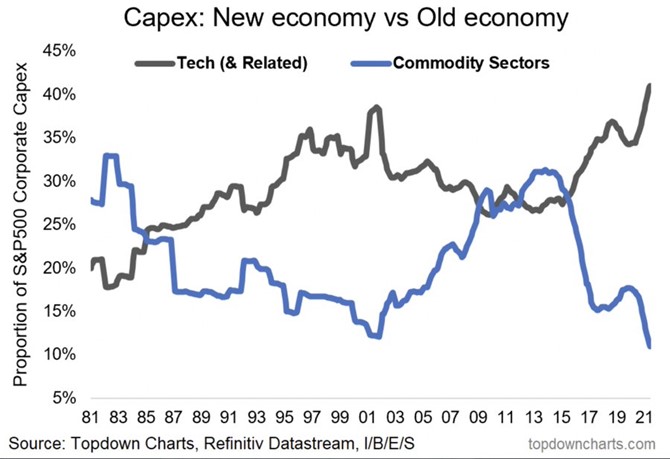
We don’t invest much in new mines these days. They are difficult to find, hard to finance, and almost impossible to permit with land claims and environmental restrictions. Instead, we invest heavily in New Economy technology companies while ignoring the Old Economy commodity suppliers that produce what goes into building all that new stuff.
In silver’s case, we need more and more in medicine, solar power, mirrors, batteries, electric vehicles, and even cloud seeding to induce rain.
Here is a graph showing corporate expenditures on technology and commodities. In the end, we need both.