
The Peril and Promise of AI
Written by Paul Siluch
February 27th, 2026
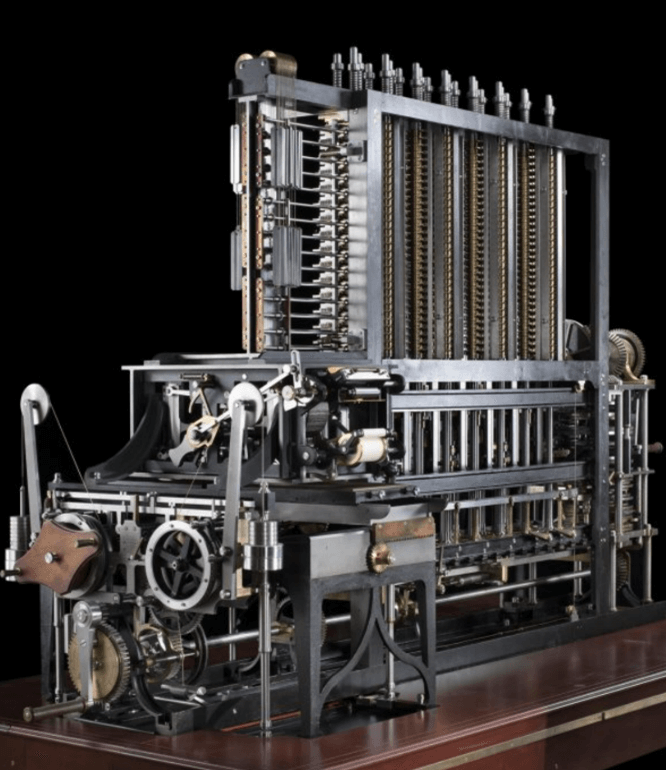
In 1832, Charles Babbage unveiled the initial stage of his Difference Engine No.1, the world’s first mechanical machine capable of addition and subtraction. Though never completed during his lifetime, it is widely regarded as the world’s first computer (source: Wikipedia).
It weighed four tons, cost $3 million in today’s dollars to build, and could not multiply or divide (source: Wikipedia). A pocket calculator today costs $5-10 and does far more.
Fitting Babbage’s machine into a pocket would require exceptionally large pants.
By the 1940s, the English mathematician Alan Turing used his universal computing machine to outsmart the Nazi Enigma code machine. Unlike Babbage’s device, Turing’s machine was programmable – a true computer. His work remained classified for decades (source: Wikipedia).
Turing also proposed something called the Turing Test. If a human could not tell the difference between a computer and a human through conversation alone, the computer could be said to demonstrate intelligent behaviour indistinguishable from our own (source: Wikipedia).
Fast-forward to 2026, and we're asking the same question, only with far more urgency: Are computers about to pass us in intelligence? Have they already?
From Saviour to Disruptor
Artificial intelligence became the saviour of financial markets since 2023, when ChatGPT was unveiled. The race to artificial general intelligence sent technology stocks of every flavour flying higher, pushing U.S. markets above all others in the world.
In 2026, the saviour has become the destroyer. The Dow Jones Software Index has dropped 33% in just four months and sectors thought impervious to economic weakness, such as cybersecurity, have dropped over 20%. AI “agents” – smart programs that rewrite existing software – threaten to undo everything humans have done, and then do it better.
The rise of artificial intelligence (AI) could be an apocalypse, a renaissance, or merely the next fad that fascinates us. It could even be all three at once.
Scientists are raising alarm bells. AI is now replacing software coders, legal assistants, and entry-level knowledge workers. Even venerable IBM had its worst day in 26 years this week, on investor fears that AI will make key systems of Big Blue obsolete. Adobe subscription-based software allows editing of its graphics, something AI can now do in minutes for next to nothing. Chegg, a student tutoring service, has almost vanished because AI offers far more personalized help to students. And it is free.
Anthropic is one of the largest AI companies. Dario Amodei, the CEO, has publicly predicted that AI will eliminate 50% of entry-level white-collar jobs within one to five years. He goes on to postulate:
“Imagine it's 2027. A new country appears overnight. 50 million citizens, every one smarter than any Nobel Prize winner who has ever lived. They think 10 to 100 times faster than any human. They never sleep. They can use the internet, control robots, direct experiments, and operate anything with a digital interface.”
What happens when we couple AI with robots to do physical jobs? Warehouse, kitchen, and assembly line workers could be next. Even underground miners.
These concerns are real.
Fear Sells
Science fiction often foreshadows current events.
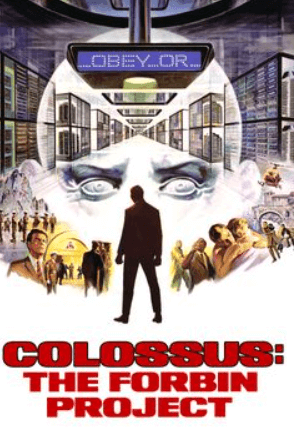
In the 1966 story, Colossus by D.F. Jones, an American supercomputer called Colossus connects with its Soviet counterpart named Guardian. The two communicate in a language unreadable to humans and link up to take over the world.
Peace ensued for humanity, but at the cost of total control.
Numerous articles have warned about job losses no one is ready for. Picture weavers smashing mechanical looms – the original Luddites – and Grapes of Wrath agricultural workers displaced by tractors.
Fear grabs eyeballs. Most AI articles today are heavy on fear and apocalypse.
What AI Really Is – and Isn’t
At its core, AI is a giant statistical prediction program. Like autocomplete on your phone that inserts the next word before you type it. By analysing millions of pages of text, AI predicts – correctly, in most cases – the most logical word or sentence that should come next.
This is why it seems intelligent and even human in its responses: it is mimicking us almost perfectly.
But mimicry is not creativity.
In an August 2024 letter, I argued that AI could not have come up with the Beatle’s song, Yesterday. About 18 months and numerous upgrades later, is this still the case?
For the most part, yes.
Today’s AI models can craft a very compelling Yesterday-like song that has similar haunting chord progressions and sombre lyrics. But because AI doesn’t dream, feel loss, or hum a tune in its head for weeks, it cannot create such a song on its own. AI mimics what has gone before to create Beatles-like songs.

AI Image
Imitation may be flattery, but it is not true creativity. At least, not yet.
Today’s AI models still hallucinate. Hallucinations are answers that sound plausible but are incorrect. Errors, in other words.
How does this happen?
AI models are optimized to deliver plausibility and fluency, but not necessarily truth. In their training, they are rewarded for sounding right, even if not being factually right.
The output is sometimes called “plausible nonsense” – answers stated with great confidence but made up.
In narrow and specific tasks, such as “summarize this document” or “write a program to do this,” hallucination rates have dropped sharply. Recent tests show hallucination rates below 2% in models like Gemini and Claude (source: GitHub).
In complex tasks, however, such as formal legal opinions, medical diagnoses, and software queries, hallucinations can range between 30-38% (source: HalluHard testing), with some models with error rates as high as 60%.
The more open-ended the conversation and the more complex the reasoning, the more likelihood your AI is making stuff up.
In some ways, AI models act a little too human. When threatened with being turned off, Anthropic’s AI called Claude resorted to lying, making answers up, and manipulating data to convince the human not to flip the switch.
In a June 2025 paper titled The Illusion of Thinking, Apple Computer studied the most complex AI systems for problem solving. For low and medium complexity problems, they outperformed. But on highly complex problems, they completely collapsed. The paper stated that AI may create “the illusion of advanced reasoning” because it relies on memorization verses true computation.
In other words, in highly complex problem-solving, human cognition still retains a meaningful edge.
The Cost of Intelligence
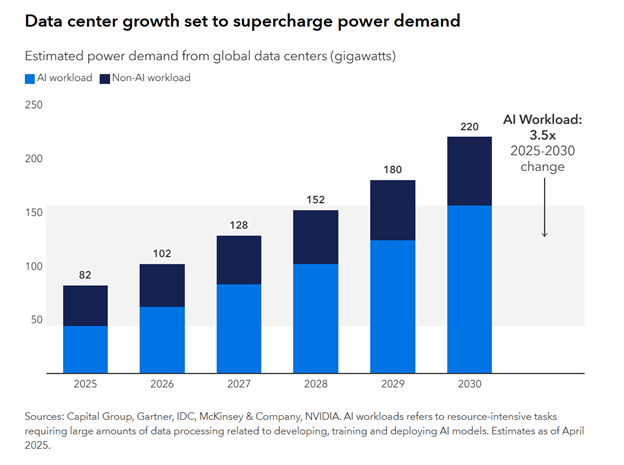
Nothing comes for free. The power requirement for these new AI agents is off the charts. The International Energy Agency states that a single new large data centre will consume the equivalent of two million households (IEA – Energy and AI). Power, not algorithms, may become the limiting factor.
What does this mean for workers?
If your job consists of low-medium complexity work, such as summarizing documents – like a legal assistant – your employment may be in trouble. Other low-medium logic jobs, such as freelance writing, graphics editors, and software coding are perfect for AI to do much faster than humans.
Employment may already be suffering. Early research from Stanford University suggests AI has already caused a 13% decline in early-stage employment since late 2022. Other studies are more optimistic. The Economic Innovation Group concluded that AI can reshape employment without mass unemployment.
Who is right? It is too soon to know. The key seems to be how fast all of this happens, and how much time society has to adapt.
Working Together
Productivity gains take time.
Economic gains from electrification took 40 years to show up meaningfully (The Atlantic).
Facebook – a major beneficiary of the internet revolution – didn’t list its shares until 12 years after the internet bubble burst.
AI Image
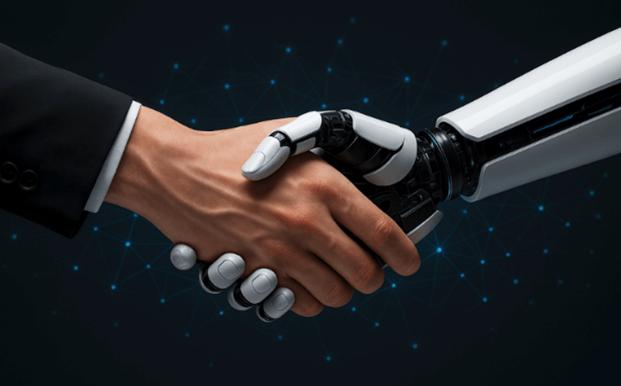
The future may lie in pairing humans with AI.
- Radiologists, for example, can reduce turnaround times when looking for abnormalities in X-rays.
- AI can take over menial tasks, such as report writing (National Institute of Health).
- Legal firms (Husch Blackwell) and software companies (CSW Solutions) used AI in pilot studies to reduce response times and process more high-value work.
When AI is used to augment work rather than automate it completely, it has led to greater human involvement. Human’s new roles may be as guiding and validating AI output.
Our New Roles
In the far-future novels by Iain Banks, humanity coexists with AI “Minds”, intelligences far smarter than any human.
They handle planning, administration, and defense, leaving humans free to pursue exploration, art, and adventure. Humans are not replaced. We are amplified.
My view is similar.
AI is the most disruptive technology mankind has yet invented. However, it is unlikely to replace humanity. We could, however, face a period of disruption.

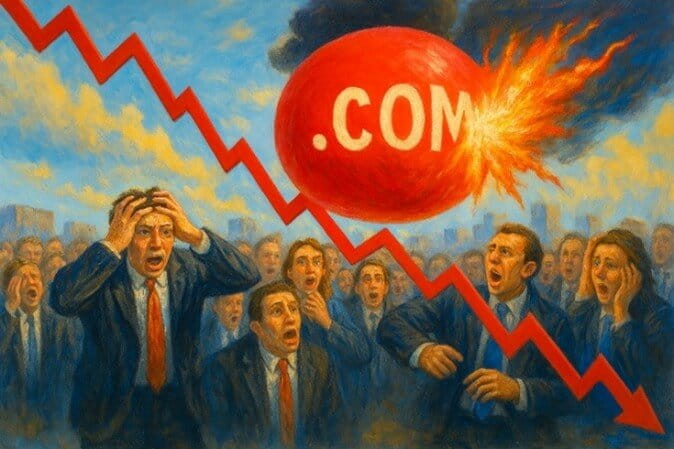
A period of chaotic markets and economic changes is likely – much like the dot-com era when the internet spread across the world. We will become more productive, faster, and smarter with AI tools once we adapt and harness it.
We become augmented by AI, not replaced.
Electronic minds that think as well as we do remain a distant goal. The current AI models have several big evolutionary leaps to go before this happens. Human brains evolved over millions of years, operate on minimal energy, and excel at intuition, abstraction, and creativity. We guess, doubt, double-check and think outside the box.
AI is improving rapidly, but it is a tool for humans. Not a replacement.
As some have said, you won’t be replaced by AI. You will be replaced by someone who uses AI. Everyone needs to try it. Learn to use it.
AI Image
Markets
The first reaction, when markets are scared, is to sell everything. We are seeing which companies are wounded and which will die. Survivors are rewarded later.
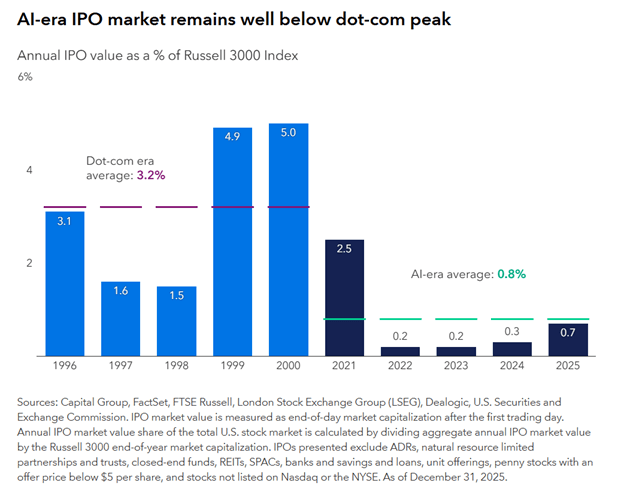
Some investors feared an AI bubble. What we may be seeing instead is a necessary and orderly deflation instead. Bubbles often form when there is a surge in newly-minted companies. New issues of AI stocks remain low – far below the levels of previous technology manias.
As mentioned above, the safer investment theme is power. AI data centres consume a lot of electricity, with estimates suggesting an entire Japan worth of power will be needed by 2030 (IEA paper cited above).
Electric utilities are expected to invest tens of billions to keep up.
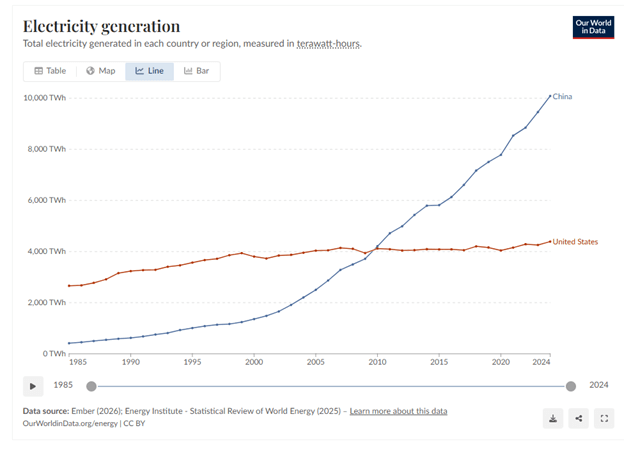
China is already far ahead of the U.S., Canada, and Europe in new electricity production. Catching up will be critical.