

Tear Down This Wall!
Written by Paul Siluch
June 6th, 2025
“General Secretary Gorbachev, if you seek peace, if you seek prosperity for the Soviet Union and Eastern Europe, if you seek liberalization, come here to this gate.
Mr. Gorbachev, open this gate!
Mr. Gorbachev, tear down this wall!”
- President Ronald Reagan, address at the Brandenburg Gate, June 12, 1987 to open the Berlin Wall, which had encircled West Berlin since 1961.
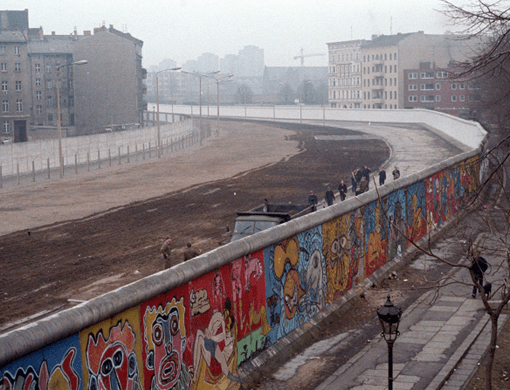
Wikimedia Commons: Berlin Wall 1986 by Thierry Noir
A barrier is a wall meant to keep someone, or something out.
Hadrian’s Wall was built by the Romans in Britain to keep the barbarian Picts and the Scots from invading south. The Great Wall of China kept the northern tribes of the steppes at bay.

Free Images
Barriers also keep people in. The Berlin Wall isolated communism’s quarter of Berlin, preventing anyone from seeking freedom from 1961 through 1989.
Barriers don’t have to be physical constructions. Countries use laws and regulations to protect their domestic markets, especially when they are young and vulnerable. Japan grew its auto industry behind stifling import taxes in the 1970s and 1980s, making Toyota the world’s leader in internal combustion vehicles.
China has now done the same thing 30 years later, with BYD leading the world in electric cars.
Canada is a trading nation. We negotiated NAFTA in 1992 with the U.S. and have signed more recent agreements with Europe and Asia.
Why? More trade lowers prices. It allows industries to grow through global sales, even as the risk of increased competition can hurt smaller local companies.
Canada has ten provinces and three territories, all of them fiercely independent. Compared to the 50 states of the United States, Canada’s provinces have vastly more autonomy in terms of language and immigration rights (at least Quebec does), control over their resources, health care policies, and educational requirements. Even building codes and tire sizes can be completely different between provinces. We are a loose confederation of regions, compared to America’s more united states.
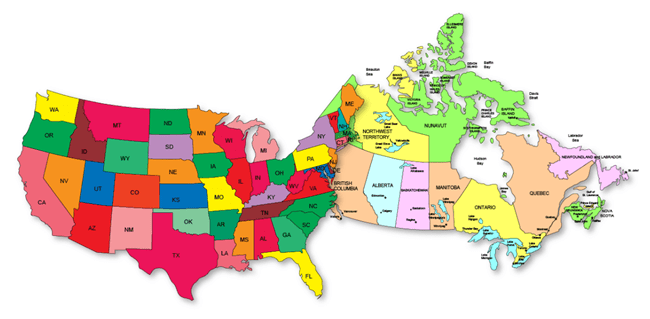
FreeUSandWorldMaps
And we love our trade barriers. Especially between one another.
Bureaucratic walls may have protected provincial rights and local economies once, but in the era of President Trump, they are a liability. If we can’t trade freely with each other, how can we demand the same of our north-south trade with the U.S.?
Take alcohol, for example. British Columbia’s Okanagan Valley has over 200 wineries and is often compared to California’s Napa Valley in terms of quality of wines.
Do Canadians benefit from this? The only way to get B.C. wine to Ontario is to ship it through Ontario’s Liquor Control Board for sale in their government stores. Anyone caught mailing it directly to a non-government buyer can face fines up to $250,000.
"It's easier to get a wine from Australia than it is to get a wine from B.C."
- Moshe Lander of Concordia University in a CBC

Adventures in B.C. Wine
Other examples abound:
- In most cases, you must physically transport your alcohol yourself across provinces – you cannot mail or direct-to-consumer ship it privately. And even this can result in fines. You can buy beer in Delaware and legally cross into Maryland but crossing from Quebec to Ontario risks arrest!
- Quebec labels its fruits and vegetables differently than other provinces. Its strict language laws prevent many English-speaking companies from selling products due to the long list of French signage and proficiency requirements.
- B.C.’s provincial chicken board sets the price of chicken here, making our wings and thighs some of the most expensive in Canada.
- Cities that straddle borders, like Lloydminster in both Alberta and Saskatchewan, were prevented from selling a sandwich made in one province into the other until 2024 (Government of Canada Food Inspection Agency).
- Nova Scotia’s maximum weight for trucks is 1,000 kilograms lighter than in the other Atlantic provinces (Public Policy Forum). They must unload part of their containers before crossing the province, load it into a second truck, then refill the first truck once they exit Nova Scotia.
- Professions such as nursing and accounting require different credentials and courses across the provinces. Financial professionals like us need to pay separate licensing fees in every province, despite having a national body and national standards. Same thing for many skilled trades, like elevator mechanics.
How Long Has This Been Going On?
Recognized as an impediment as early as the 1960s, Canadian provinces signed the Agreement on Internal Trade (AIT) in 1994 and furthered it with the Canadian Free Trade Agreement (CFTA) in 2017.
These have helped. But we still can’t mail wine.
There are other barriers too. Universities restrict residencies and internships to in-province students, shutting out in-province students who had to leave the province because the universities were full.
Provincial Medicare programs prohibit private provincial clinics from charging residents for medically necessary procedures covered by Medicare, such as knee replacements.
Some hospitals in remote areas, like northern B.C., have 90-week waiting lists. Almost two years. It is very hard to wait that long when you can’t walk.
B.C. residents are prohibited from paying for a new knee in their own province, so fly to Alberta to pay for the service. And they wave at Albertans flying to B.C. because Albertans are banned at home in exactly the same way!
Taxes may be one of the biggest barriers.
Alberta and the territories charge only the 5% national sales tax (GST).
Ontario charges a 13% harmonized sales tax (HST), while B.C. charges 12%. Companies selling to both provinces must be careful when calculating these taxes.
It is worse in Quebec. Quebec’s combined sales taxes are 14.975% and the province’s liquor distribution arm, the SAQ, adds up to 134% to the price of a bottle of wine or beer.
Before President Trump, Canada paid an average of 1.4% tariffs on its international trade. That was certainly manageable.
What do our internal barriers cost us? A 2020 Statistics Canada study determined our interprovincial trade barriers add the equivalent of 6.9% in tariffs on all Canadian trade.
This makes us our own worst enemies.
The Canadian Chamber of Commerce estimates Canada could lose up to $75 billion per year if the U.S. imposes 25% tariffs on all our exports.
Reducing our own barriers could add $50-100 billion in savings per year (Canadian Centre for Policy Alternatives). Other studies point even higher – gains of over $200 billion per year (IMF 2019).
This translates to up to $5,000 per Canadian (ScotiaBank 2025).
In other words, whatever we might lose because of the U.S. tariffs, we could gain by trading more freely between provinces.
Of course, lowering barriers means lower local revenues, fewer tax dollars for politicians to spend, and more competition for small local companies. Canada has attempted to lower its trade barriers before, with limited success. Some barriers, like Quebec’s French-based civil law will forever remain an impediment to the rest of the provinces (and the U.S.) which use the British common law.
But we have never been as threatened economically as we are now. And, perhaps, more united in our determination to remain independent.
The recent meeting between the premiers and the new prime minister ended with high hopes for new projects and freer internal trade.
Let’s hope those hopes can be converted into action.
Shifting Tides
Despite Canada – and the world – having issues with U.S. tariffs, we have seen a strange decoupling this year.
- Canada’s stock market sits at all-time highs.
- European markets sit at all-time highs.
- U.S. and Chinese markets are now lagging.
Two things have happened.
First, the tariff threat has fallen from the highest-level threat to something now called TACO: Trump Always Chickens Out.
However it works out – the U.S. charging a little less or the world paying a little more - the world is moving closer to some sort of tariff agreement that will be manageable. It has to be.
Second, Europe and Canada are now viewing their dependence on the U.S. and China as weaknesses, not strengths. Both are about to spend much more on defense and infrastructure, and are actively seeking new trading partnerships.
Stocks like it when more money is spent. And on a relative basis, more may be spent in these economies that in the U.S. or China – both of which have already overstimulated and are cutting back.
We experienced 15 years of U.S. stocks outperforming those in the rest of the world. That tide may be changing.