
Looking Foolish
Written by Paul Siluch
February 6th, 2026
When you have been in the business long enough, very little shocks you anymore.
Many things still surprise me.
This one surprised me: young people are dancing less.

Freeimages
At concerts, weddings, and office parties, people used to bust out moves and go crazy for an evening. Whether the beat is to sticks on skin drums or electric instruments, people like to move.
Our parents jived and waltzed whenever they could, while my generation was swept up in disco fever. The lights, the polyester suits – we wanted to be seen.
At one point, there were as many dance clubs in my hometown as there are coffee shops today.
Now? They watch from the sidelines.
What changed?
Cell phones.
“There’s a feeling that, if you do something stupid, there’s a chance that you’re going to become a big joke or the next meme,” was the quote from Marcos Sandoval-Ramirez, a 21-year-old, in the Wall Street Journal.
“Spend a little time on social media, and you will see a video of some guy doing something stupid,” he added. “You laugh, but there’s always that small part of your subconscious that goes, ‘you know that could be me, right?’”
Wireless phones and social media have changed a lot of things. For example:
- Talking to yourself in public? Once weird, now just annoying.
- We used to bump into friends at the mall and chat. Now we 'like' their vacation photos from the couch.
- We used to tell jokes around the water cooler. Now we forward memes.
- We once voiced opinions openly. Now we hide behind pseudonyms – because honesty can get you in trouble.
Fads and trends come and go. Fashion trends, like bell bottoms and torn jeans, were relatively short. Some fads last a generation, like tattoos and skin piercing, while others are even longer. Smoking, for example. It took society several generations to get rid of that.
Social media spins around ideas and trends faster than ever before. By encouraging more people to do the same thing at the same time, we get crowding behaviour. What used to take months to propagate can now take weeks or even days.
All things have their season and time in the sun. Trends come and go, and what was cool and smart once are discarded today. We will dance again, in other words.
Market Fads
Investors follow popular themes the same way people follow fashion — until it suddenly looks ridiculous.
Much of this has to do with profits. People follow the sectors making money until they stop.
And investors are subject to crowding behaviour, just as fashion is. Few professionals want to reveal at the end of each quarter that they were buying falling stocks in weak industries, such as energy or packaged food today.
Who wants to be the investment manager equivalent of the awkward dancer?
No one wants to be the investment manager who looks foolish before everyone else does.
The ‘hot’ cycles of 2023 through 2025 may have started to fade.
Bitcoin and cryptocurrencies, AI, tech, drone stocks, and even gold have had tremendous runs these last two years. Index investing encouraged this further by forcing people into the same baskets of stocks.

When investment funds and traders all hold the same positions – leaving no one left to buy when they want to sell – we may experience violent rotations. This has occurred in the last few weeks.
Technology stocks are being hit, on fears of spending too much on AI for too little return, and gold is tarnishing because everyone who wants gold may already have enough.
Gold
Let’s talk about the gold cycle for a moment. Many investors – including some of ours – are invested in precious metals. The reasons why are well-known by now.
- Governments are deficit-spending like there is no tomorrow and printing money to pay for it.
- Gold is the world’s oldest currency and rises when people get nervous about debt and debasement.
Gold’s last big runs lasted over a decade.
- 1970s: The rise from $35 to $850 in 1980 saw gold drop -45% from 1974 through 1976. Many investors gave up, only to watch it quadruple from 1976 through 1980.
- 2000s: The same happened when gold rose from $250 in 1999 to $1,900 in 2011. The slumps in 2004 and 2008 made many lose faith, only to watch it soar even further.
- 2020s: The recent run in gold started in 2019, with gold around $1,200 per ounce. It almost doubled during the crazy money printing of the pandemic, then did little for three years. From 2024 to today, it has risen from $2,000 per ounce to $5,600. A very big move.
Big moves are like big meals: they need time to digest. Is it over? Governments aren’t reining in their spending and inflation is still elevated.
But goldbugs will have to be patient.
If the bull market in gold is going to continue, it could take months or even years before we see new highs again. I think gold will “dance” again – gold is only up 4x from its low in 2019 versus 8x in the 2000 run and 22x in the 1970s.
This isn’t a hard prediction – just a comparison of past moves and experience.
Big secular trends don’t end quietly — they exhaust investors first.
I’ve made this mistake myself more than once.
Rotations
As 2026 starts, we are seeing a huge rotation back into unpopular and boring sectors.
| • Pharmaceuticals (IHI ETF) | + 8% this year |
| • Consumer staples (XLP ETF) | +10% |
| • Technology (XLK ETF) | - 6% |
| • Gold | -17% in a rough week |
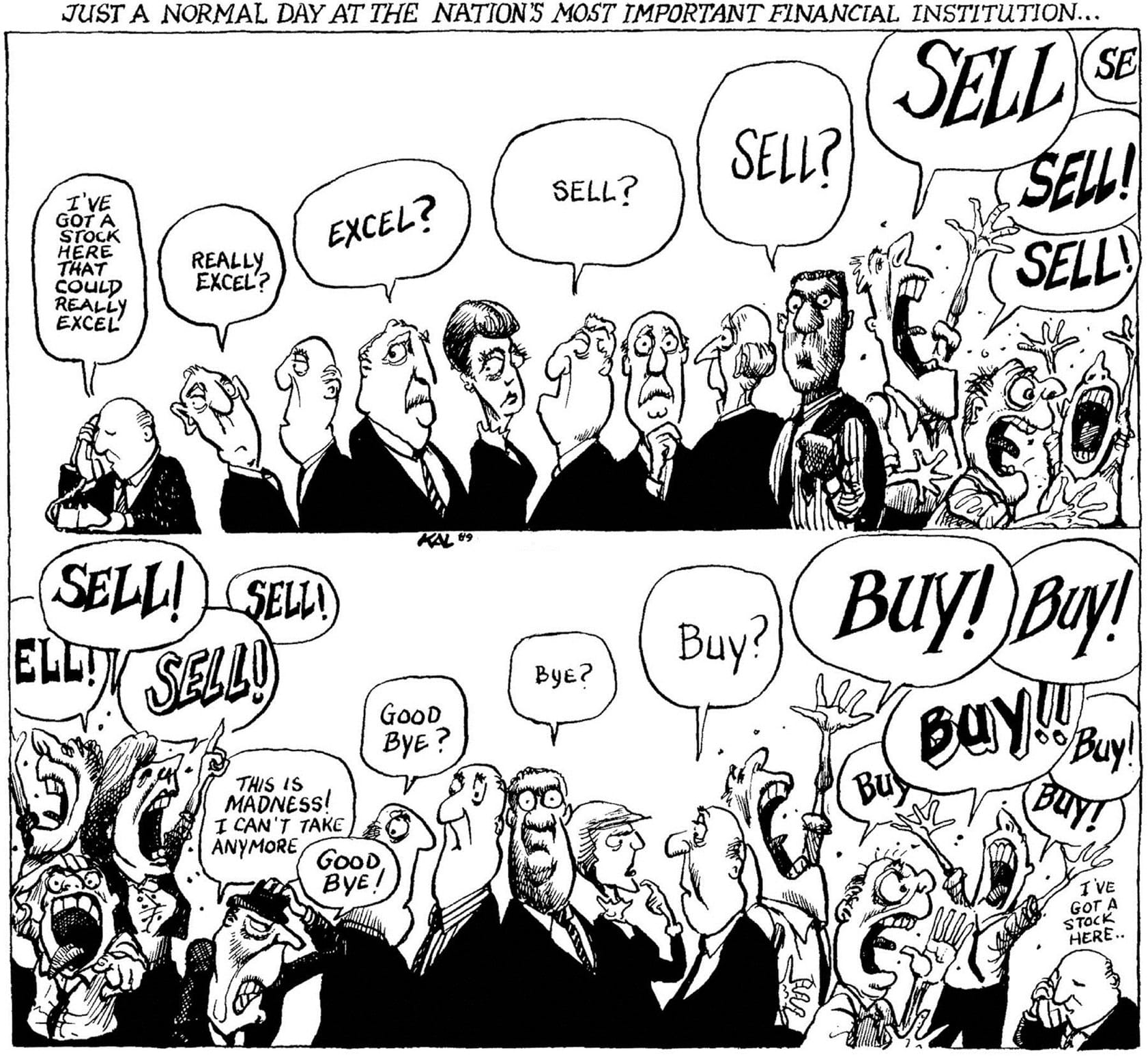
Cartoon by Kal
When you see moves like these at the start of a year, it usually tells you more about emotion than fundamentals.
Are the former darlings dead? Should we be selling computer chips and buying potato chips?
As mentioned above, rotations like this come and go. Some are short-lived and end suddenly. Others persist for a decade but shake you out along the way. Bull markets do that. The technology sector remains in a very long bull market, so should regain its momentum.
Physical Over Digital
As social media and AI grew – as well as the companies riding this wave, like Meta, Alphabet, Microsoft, and Nvidia – the world focused on the digital world rather than the physical world.
Why think about the power needed to light every screen, the magnets in our electric cars, or the copper in the wires? We had plenty of everything.
Until we didn’t.
Artificial intelligence is demanding more and more power, and the wires to transmit it. Electric cars need rare earths for the magnets in their motors, just as China started restricting shipments. Solar panels are big users of silver.
What if the next big winners aren't what’s on the screens... but the copper, rare earths, and electricity behind the screens?
We want to invest in this trend. Our problem? As conservative investors managing dividend portfolios, the commodity world is a rough and dangerous place. Minerals and energy are often found in troubled countries in rugged ground. Few companies in the commodity world are stable enough to pay regular dividends and generate consistent profits.
Both are things we want.
To participate in commodities, we chose BHP for our Dividend Value portfolios.

Formerly known as Broken Hill Proprietary, this Australian giant has paid a dividend for 130 years. It is the largest iron ore producer in the world, the #2 copper producer, plus significant amounts of uranium, gold, and silver. BHP is active in Saskatchewan with its new Jansen potash mine.
The upside isn’t as explosive as junior commodity producers, but BHP can still appreciate nicely if copper prices continue to rise. And if India industrializes even half of what China did, iron could enjoy a new dawn.
Meanwhile, the 3% dividend is a decent cushion if commodities are not as strong as we expect.
Estate Planning Journey
Over a year ago, I decided to go back to school. Raymond James now owns a trust company called Solus, so I enrolled in the Trust and Estate Professional (TEP) course, a two-year series of four exams to help me understand what happens to your money when you die.
It was a lot more than I expected. Studying is much harder than it used to be.
Nonetheless, I have completed the Law of Trusts, Taxation of Trusts, and am now in the heart of the Administration of Trusts. Executorship, probate fees, all of that.
Many important points.
- Don’t die without a will. It sets your heirs up for a world of problems. Review your will every 3–5 years (or after life changes like marriage, divorce, grandkids).
- And don’t appoint a child as executor if they live outside of Canada. Even appointing someone outside your province can cause problems.
- Consider a family trust for smoother transitions.
- Review your beneficiary designations and joint holdings on accounts.
I thought living in the investment world was hard. Dying in it is even harder!
It is a giant learning curve but one I am actually enjoying.
We will be adding more estate planning resources to our website this year.
If you haven’t reviewed your will in the last five years — or if family circumstances have changed — it’s probably time.