

Who Wants To Live Forever
Song by Queen (1986)
Written by Paul Siluch
May 29, 2026
- How do you sell life insurance to someone who may live to 150?
- Science is helping us live longer
- Caring for ailing seniors is one of the biggest growth industries.
- We already have too many old people
- S. Social Security Pension faces a shortfall of $27 trillion by the year 2100 (S.S. Trustees report, 2025).
- We have too few young people supporting these old people
Most of our letters have a distinct investment focus. Readers finish with an “I can invest in that!” conclusion.
This is not one of those letters.
Sometimes, a theme is just too broad and too far-reaching to be investable today. But those same big themes are also highly important and worth deeper thought.
Let’s dive into one of the most important themes of the century.
Humanity’s Plummeting Birth Rate
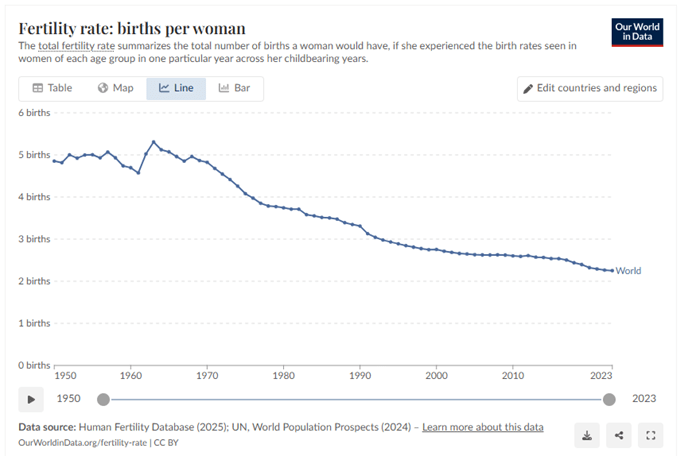
Since 1950, the world’s birth rate – defined as births per woman in her lifetime – has declined from five children to barely above two. To fully replace yourself in the population – to keep it exactly level generation after generation – requires a replacement rate of 2.1 children.
Slightly more boys than girls are born each year worldwide, and then we must account for some measure of infant mortality. This means we need 2.1 children from every woman to achieve a steady replacement rate.
In 1968, the book The Population Bomb by Paul Ehrlich was published. It predicted a world choked by too many people, leading to famines and global calamity. He was right about the population growth but wrong about everything else.
Ironically, 1968 was almost exactly the year when global fertility rates began their steepest decline. Within 20 years, global fertility fell from five births per woman to below three.
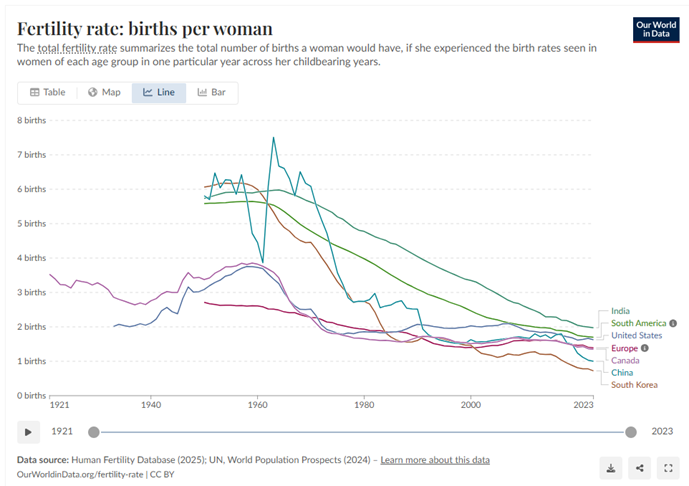
The curve for virtually every country declined after the late 1960s:
Statisticians have been expecting birth rates to grow faster than they have for decades.
In 2012, the United Nations predicted that global population would continue to grow through the year 2100, with as many as 12.3 billion people living on Earth. By 2022, this estimate was slashed to a peak of 10.4 billion by 2086.
Two billion less.
Now, other estimates suggest we may peak 30 years earlier – as early as 2055 with just 9.2 billion people (Earth4All).
Currently, 2.1 births per woman is the necessary fertility rate to keep the population flat. Europe and North America have seen big declines in the number of births, to no one’s surprise. Look at the countries and regions now below this rate:
1.9 India
1.7 South America
1.6 USA
1.4 Europe
1.35 Canada
1.21 Japan
1.0 China
0.72 South Korea
Why?
Asia’s population growth slowed more rapidly than expected. China’s one-child policy in the 1960s resulted in China losing population today. In just two generations, it could see its population decline by 75% (just 50-60 years).
Will it get better for China soon? Not likely. In the most recent China General Social Survey, young women were asked family formation questions. The share of young women stating “no desire for children” increased from about 5% in 2012 to 47% in 2023.
Half of all young Chinese women want no children at all.
At 1.9, even India – the world’s most populous country – is also below the replacement ratio.
Baby Bonuses
A number of countries are trying hard to raise the birth rate. Generous maternity leaves for mothers, paternity leaves for fathers, and tax breaks have been tried across Europe.
Has it worked? Europe’s fertility rate of 1.4 suggests not.
Hungary has been one of the most forward-thinking of nations. That nation now pays close to 5% of its GDP toward raising its fertility rate (The New York Times) – higher than its defense budget. Hungary does this by slashing income taxes to zero for mothers raising four children. This will be lowered to families with just two children in 2026.
Has it worked?
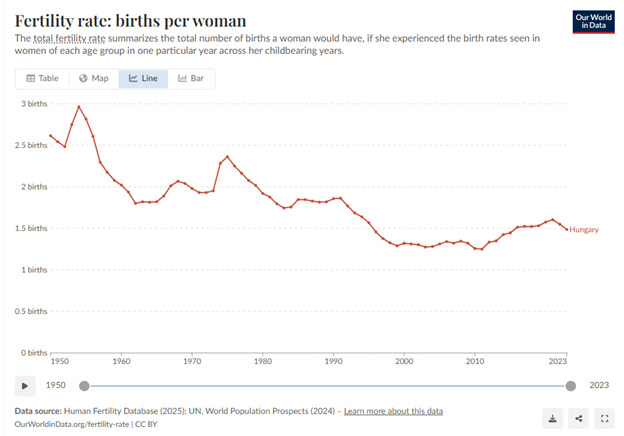
Hungary’s birth rate rose from 1.2 children per woman to 1.5. It is not replacement level yet, but it is better than most countries.
And yet, still not enough.
Declines in population are nothing new. Rome needed soldiers in 9 AD because the population wasn’t creating enough. The Roman emperor Augustus passed laws to punish people who “avoided” having a family.
Some historians say Rome was not conquered from without, but collapsed from within – a result of its falling birth rate.
What Changed?
In the modern day, the predominant question is why.
- Why did the global fertility rate fall sharply in the 1960s?
- Why again around 1990?
- Why the drop after 2008?
The U.S. fertility rate declined from four babies per woman in 1960 to three by 1970. Then to two by 2000.
It has dropped a further 20% to 1.57 today – a sharp decline, for no obvious reason.
There are several theories that could account for the decline in women having more babies.
1960s: The birth control pill was approved by the FDA in 1960 and became widely available worldwide by 1969. For many women, fertility became a choice.
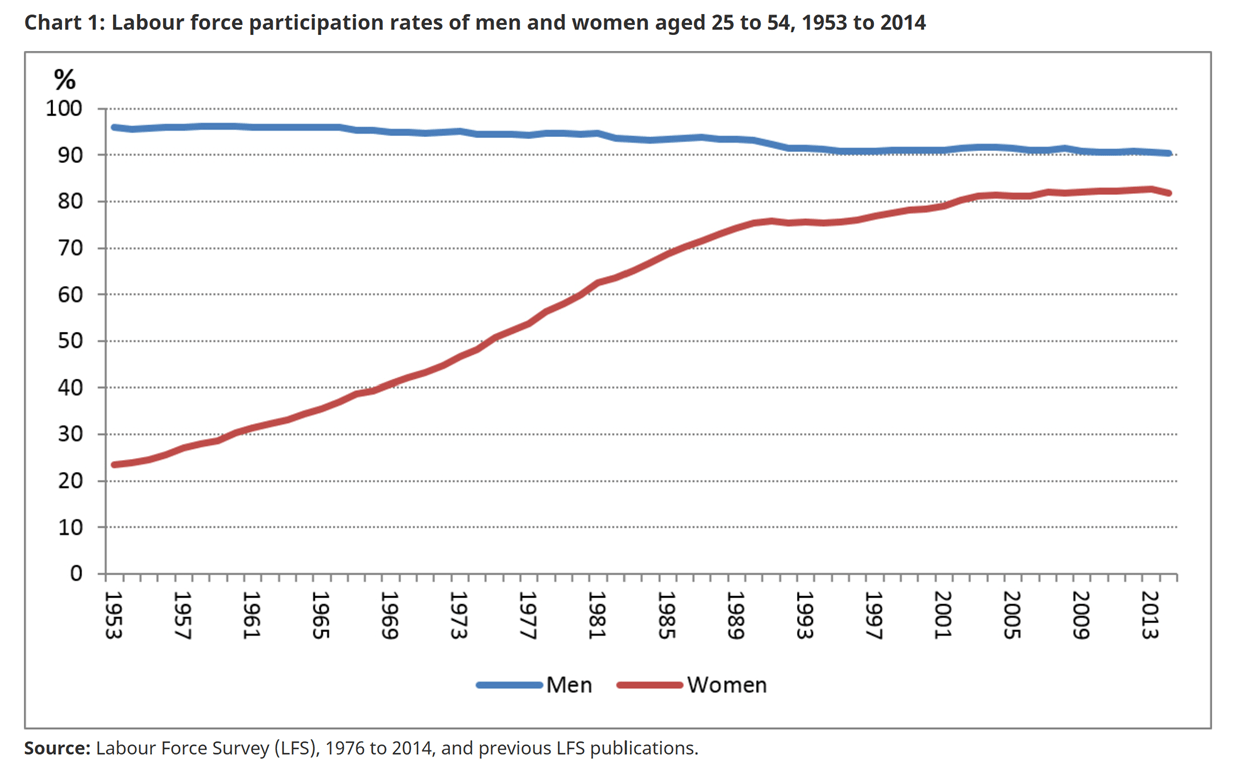
With the rise of women’s rights, education, and birth control, more women entered the workforce. In Canada, women working outside the home went from 25% in 1953 to over 80% by 2013 (Statistics Canada).
Some statisticians point to urbanization.
1970s:
China’s rush from the farm to big cities began with Deng Xiaoping (“To be rich is glorious”) and his reforms in 1977. City life is more expensive than farm life and living quarters are smaller. This coincided with a global boom in service jobs, with fewer in factories and agriculture.
Some say the biggest change is due to smartphones.
2000s:
The Apple iPhone was born on January 9, 2007, marking the beginning of the smartphone era. A new form of digital connection called “social media” followed, leading to a widespread decline in physical interaction in favour of online interaction.
“2007 was the year the (smartphone) rolled out across the richer countries of the West, and by three years later, 34% of British people and 27% of American people had one.
The birth rate was stable in countries like the US, the UK and Australia in the early 2000s, but in 2007 it started dropping in all those countries.
They reached France and Poland two years after that, and middle-income countries like Mexico and Indonesia three years later (2012). They finally became commonplace in Africa in 2013-15 – and in every case there is a steep, permanent drop in the regional birth-rate at exactly that point.”
- Gwynne Dyer: Is Demographic Collapse Really A Good Idea?
Smartphone use also led to an activity called ‘doomscrolling’ where you become addicted to scrolling through pages of alarming news.
Afraid of wars, climate change, or conspiracies? Social media gives them all to you at once. And when it learns what you read most, it feeds you even more.
This amplification of impending doom drove fewer young people to want to bring children into the world.
2010s:
Add in the exorbitant cost of housing and you really slow down family formation.
“Today’s generation is too anxious about the future to make the irreversible commitment of having a child.”
- Anna Louie Sussman: Inconceivable
Some will say this is an irreversible calamity. Others will say the opposite – the Earth will be better off with fewer humans.
However you slice it, an aging world with fewer babies is a slower world. Living and investing under such conditions could be very different from what we are used to.
Before we give up hope, remember that when a problem seems at its worst, a solution often appears.
- Curbs on smartphone use in several countries could help us reconnect in person.
- 3D-printed houses might lower home costs dramatically.
- Those 0% tax rates for multiple-child families might actually work.
Solutions like these will still take years to turn the tide.
Fewer Births To Longer Lives?
Let’s turn this fertility problem on its head.
If we have fewer babies, what if the ones we do have lived longer?
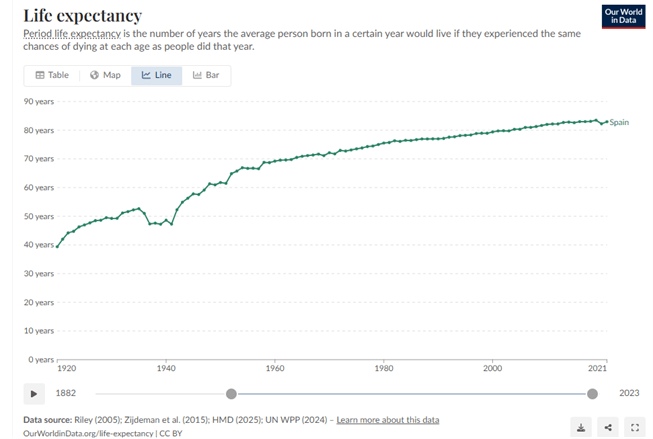
Humans today are already living more years due to better health and medications. The global life expectancy in 1920 was 40 years. Today, it is 80 years. This could change the math of a shrinking population.
The Holy Grail
Ever since civilization began, humans have dreamed about living longer. The Egyptians embalmed themselves to prepare for the Afterlife. The Spanish searched for the Fountain of Youth, a legendary spring that granted youth to anyone who drank it or bathed in its waters. The Knights Templar sought the Holy Grail with its promise of eternal life.
In incremental steps, the Holy Grail is already here, but it is science that is the modern cup. Lifespans shot up in the decade after WWII and have increased ever since. What changed?
Antibiotics. First used in the war, antibiotics became widespread by 1945 (Oxford, UK study). They were the new miracle drug for infections that normally killed millions. Global life expectancies grew from approximately 55 years in 1945 to 70 by 1960.
Policy. Better nutrition, fewer smokers, and lower infant mortality pushed life expectancies to 80 by 2000.
The Genome. Biology changed forever with the advent of the internet. In 2003, scientists finally decoded the human genome.
“In 2003 scientists read the whole DNA of one person. It took 13 years and $2.7 billion dollars. Last month a scrappy San Diego startup named Element Biosciences did it for 100 bucks!”
- Stephen McBride
Old Can Be Young Again
 Getty Images (1268654991)
In 2006, a professor named Shinya Yamanaka discovered four proteins – called transcription factors – present in all human cells. These ‘Yamanaka factors’ can be reactivated in adult cells to turn them back into a youthful state.
One of the top areas of venture capital funding today is life extension. Funded by tech billionaires like Jeff Bezos, Sam Altman, Peter Thiel, Larry Page, and Mark Zuckerberg – the high priests of the modern technology – companies are pouring money into living longer. To the tune of almost $13 billion in venture capital so far.
Are these pie-in-the-sky dreams? Life Biosciences in Boston has already started a Phase 1 study to rejuvenate eye cells to cure glaucoma. Why look for a drug when a young eye is the cure itself?
One of the largest private companies, Altos Labs, is using the Yamanaka factors to reprogram old cells to be young again everywhere, starting with skin. Imagine a damaged heart that becomes young again and repairs itself?
Others, like Unity Biotechnology, say disease is a result of old “senolytic” cells clogging up in the body, and their science is working on eliminating these.
While AI raises fear in many people, it is also accelerating the rate of discovery. Lab rats could soon become a thing of the past as experimental drugs are now tested in software and on chips in a fraction of the time.
Live Long and Prosper
Studies done for Nature Aging show the limit of lifespan averages around 84 for men and 90 for women.
Using cell reprogramming and AI-assisted drug discovery to repair cellular damage as we age, some scientists argue we could push life expectancy to 150 years (source: Harvard).
Returning to the problem of the fertility rate, extending life does not change the mathematics of falling birth rates. It just extends the decline.
This is where research gets even more interesting.
Companies and universities in the U.S., China, the Netherlands, Japan, and Australia are working on artificial wombs. Some are for animals only. The most advanced for humans is from the Children’s Hospital of Philadelphia called a “biobag” to support very premature babies.
The Japanese government is one of the biggest investors in this early technology. It makes sense when you have possibly the oldest population on Earth. If families don’t want to give up careers or health to give birth, maybe they won’t have to.
We have guided evolution in small steps for millennia. Now, we are about to program it. It will be fascinating to watch this new field unfold.