

The World Never Sleeps
Written by Paul Siluch
June 26th, 2026
The island of Sardinia was not, in fact, named after sardines.
It was the other way around.
Because the tiny fish were prolific around an island populated by the Sard people, they came to be known as sardines which is Greek for “of Sardinia” (savorysuitcase.com).
My wife and I travelled to Sardinia recently, a somewhat forgotten corner of Italy. It is a remote island with its capital city closer to Africa than to Rome – see below.
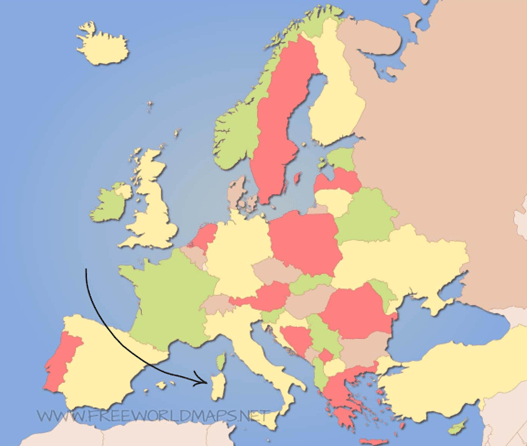
To put it in Canadian perspective, Sardinia is three-quarters the size of Vancouver Island with twice the population. It was first populated by the Bronza Age Nuraghe, one of the earliest civilizations in the Mediterranean, followed by the Phoenicians.
Humans have lived in Sardinia for a very long time. It has the oldest written document in the western world called the Nora Stone, a tablet that predates the Rosetta Stone by about 700 years.
Today, Sardinia is most known for its picturesque beaches, sandy crescents that draw tourists from all over. Unfortunately, Sardinia also has the lowest birth rate in Europe at just 0.9 births per woman (Politico), meaning the island is depopulating. We saw signs of this – abandoned farmhouses dot the interior of the island.
Tourism may help stem the tide – up tenfold since 2016 – but vacationing tourists cannot offset the drain of youth to the mainland.
As we discussed in our last letter, aging population is an issue in almost every country today.
Stuff Happens
When I go away, stuff happens.
The Iran conflict, which started in March, continued to rage through June, sending markets down 5% in just a week. The Strait of Hormuz was closed and liberated at least a dozen times, with oil prices rising and falling like waves in a storm.
And SpaceX, the largest new company to ever list, had its debut.
It was a very busy two weeks to be away.
Iran and Oil
A truce of sorts was finally signed, and oil tankers are sailing again. Some say we chose diplomacy, while others say diplomacy was the only option left due to dangerously low oil supplies.
“With petroleum inventories at home running down rapidly, top U.S. policymakers have faced an increasingly urgent deadline to decide whether to reach an agreement with Iran or attempt to re-open the Strait fully by force.”
- John Kemp, oil analyst
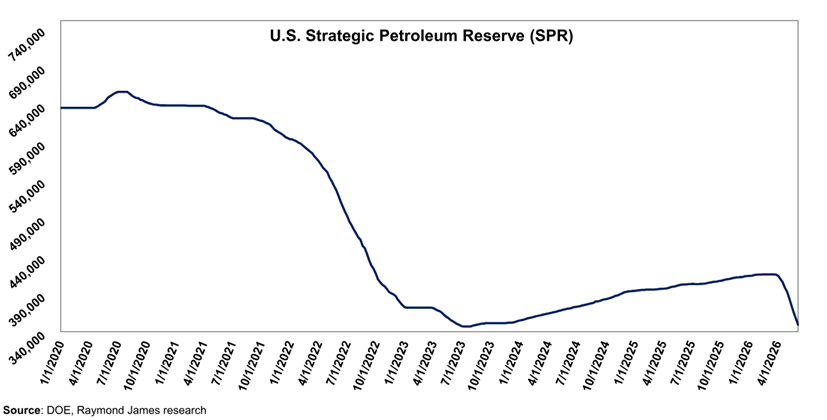
Commodity traders refer to low reserve stockpiles as “hitting tank bottoms.” U.S. reserves have been cut in half since 2020, so ‘tank bottom’ is dangerously close:
How Did Experts Get It So Wrong?
Oil at $70 is better for the world than oil at $120. Expensive oil means expensive food, transportation and heating. We can expect inflation numbers to start moderating, which is welcome news for every consumer.
The surprise to me in all this? The most knowledgeable oil analysts and traders told us the world was losing up to 13 million barrels per day during the Iran standoff.
On the surface, this was exactly right.
The U.S. and every country with strategic reserves opened their collective spigots. Plus, there was much more oil floating around in undisclosed oil tankers than anyone thought, and several Middle East countries diverted oil through overland pipelines.
Demand fell off, as well. Skyrocketing fuel prices pushed airlines to cut flights or hike prices. These led to cancellations and less fuel burned.
Factoring in pipeline bypasses, extra oil, and falling demand, the loss in oil coming from the Middle East ended up about 9-10 million barrels per day.
Experts predicted crude prices near $200 by June. Instead, oil is US $70 per barrel today.
The biggest reason?
China cut their purchases almost in half.
We know they have been stockpiling cheap Iranian, Russian, and Venezuelan crude for several years and storing it underground. But no one knew how much.
China was able to cut its imports from about 11 million barrels per day to under 7 million barrels/day (Vortexa) – a 40% drop – without batting an eye. They may have enough in reserves to live off their oil in storage for months yet.
They also pushed their electric car transition. The International Energy Agency reports that almost 60% of new car sales in China are electric vehicles. China may be weaning itself off oil faster than we think.
What Happens Next?
Now that the West has burned through most of its oil reserves and China will have used up at least a portion of its own, what happens next? How much oil demand bounces back with the Strait of Hormuz now reopened?
First, demand.
July marks the beginning of seasonal drawdowns, with summer driving season, vacations, and the fuel needs of the fall harvest. America needs to refill its Strategic Petroleum Reserve, as does China. Not all at once, but there will be a consistent bid for oil for both today and tomorrow’s storage.
Second, supply.
One would expect oil companies to crank up the drills to take advantage of high oil prices. They have seen this movie before, and it does not end well. Prices that go up quickly come down even faster, so there is little point in drilling expensive wells today when oil is about to get cheaper tomorrow. Canadian oil producers barely increased their drilling activity. Not enough to move Canada’s overall production higher.
Oil prices in January were US $60 per barrel. A new “floor” at $70-75 has likely been set due to the demand and supply issues mentioned above, plus what happens next in the Middle East. Iran may yet impose tolls on ships passing their shores, and insurance rates for any oil tanker passing missiles on both sides have skyrocketed.
While the experts have been far too bullish on oil prices so far, they are likely correct that energy remains in a bull market.
SpaceX

NASA
June also saw the debut of SpaceX, the company responsible for 90% of all satellite launches last year. The company instantly became the sixth largest company in the world and foresees its revenues rising tenfold by 2030.
We will see. Rockets have a way of blowing up at the worst times and the market loves to humble those who fly too high. The track record of newly issued company shares is not good, especially those trading at 90x revenues.
The average newly issued stock has a decline of close to 40% at some point in its first year (lambdafin.com).
Great company. Great future. Just not yet.
Your Digital Assets at Death
We wear different hats in the Dividend Value team. Mine is the Estates and Trusts hat.
I have now passed three of the four exams for the Trust and Estate Professional designation and hope to finish the last in November.
An interesting new estate issue is digital assets.
Many people today own:
- travel points and rewards
- cash-back dollars
- cryptocurrencies
- photos and videos
We think these are our property, but they are just contracts.
Contracts with social media companies, airlines, and digital banks.
Since most of the biggest are based in the U.S., it means Canadian estate laws don’t apply.
A recent case saw an Alberta court order allowing the executor access to an Apple account, but the order was ignored by the California giant. Alberta laws don’t apply to California.
▶ Do you have reward dollars? Your executor should have access.
▶ Do you have subscriptions? Your executor should have a way to turn them off.
Your will should contain clauses allowing your executor access, as well as the keys to all your passwords and the authority to use them.
Here’s a quick summary to bring up with your lawyer when reviewing your will:
- Inventory your digital assets, including all loyalty and rewards programs
- Ensure Executor Authority with a digital assets clause in your will
- Secure storage of information through a digital vault
- Enable practical access with a secure password manager
- Use Apple and Google’s online legacy, inactive account, and memorialization features for access when you are gone.
- Consider an executor or co-executor who is tech-capable
- Include a Letter of Wishes to identify which files/photos to preserve
Legal authority alone does not guarantee access. Proper planning ensures your executor can avoid delays, additional court applications, and potential loss of valuable or sentimental digital assets.
“I don’t believe this is just about Apple. This (Alberta) decision also touches cryptocurrency exchanges, gaming accounts, iCloud users, Google Drive users, and the like. Everyone has some online presence, and for many folks, the only place they have any pictures is on their device or stored in the cloud under one digital account or another.
I also think planners should be asking more questions and drafting more detailed clauses in their wills and incapacity documents. I hope and believe practitioners will adapt and can set their clients and their clients’ representatives up for success in this digital age.”
- Gregory Kaladeen, Wada Estate vs. Apple